
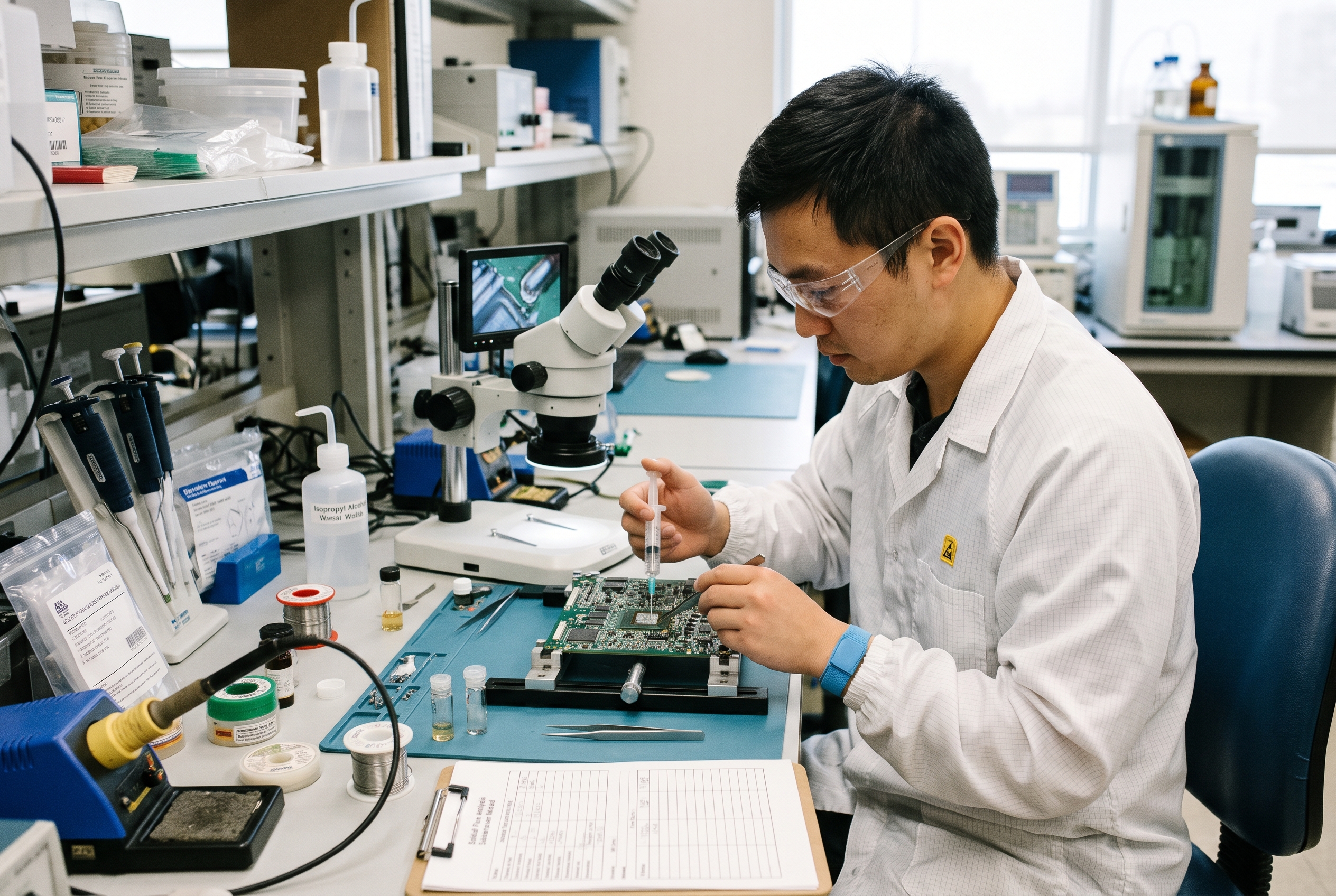
Modern surface mount electronics assembly relies heavily on lead free solder alloys and no clean flux formulations designed to streamline production without requiring full aqueous washing. While these advanced pastes boost manufacturing speed, slight deviations in reflow oven profiles or dense component layouts can leave behind chemically active residues trapped underneath miniature packages. An anion test is a precise analytical laboratory procedure utilizing Ion Chromatography to extract, separate, and quantify negatively charged ionic species, including halides and weak organic acids, left on electronic assemblies after soldering. By identifying the exact chemical composition of surface residues, process engineers prevent hidden leakage currents and premature electrical breakdown long before products enter the field.
Generic conductivity measurements only estimate total bulk ionic activity across an entire board, often masking dangerous localized pockets of corrosive acid. Species specific laboratory screening pinpoints whether contamination originates from underheated solder paste, aggressive wave soldering activators, or manual rework operations.
Ionic Flux Residues Driving Electronic Reliability Failures
Different anionic species left behind after thermal soldering attack circuit traces and solder joints through distinct electrochemical mechanisms.
- Weak Organic Acids from Incomplete Reflow: No clean solder pastes utilize organic activators such as adipic, succinic, glutaric, and malic acids to strip metal oxides during melting. When thermal shadows occur beneath heavy shields or reflow peak temperatures fall short, unactivated acid crystals remain chemically live and absorb atmospheric moisture, creating conductive liquid pathways between adjacent pads.
- Halide Activators and Localized Corrosion: Aggressive flux formulas, flame retardant laminate resins, and improper solder mask curing can release trace chlorides, bromides, and fluorides. Under electrical bias and high ambient humidity, these sharp halide ions rapidly dissolve protective oxide films on copper traces and tin solder fillets, accelerating metallic corrosion.
- Residue Entrapment Beneath Low Standoff Packages: Bottom terminated components such as Quad Flat No Lead packages and dense Ball Grid Arrays rest only micrometers above the circuit substrate. This microscopic gap blocks volatile flux solvents from outgassing cleanly during reflow and prevents factory wash nozzles from rinsing trapped ionic activators away.
Electronics Sectors Dependent on Soldering Residue Verification
Quantitative profiling of post reflow ionic residues supports long term hardware stability across demanding high reliability markets.
- Automotive Electronic Control Units: Engine controllers, transmission computers, and radar processing modules endure rapid condensation cycles and extreme underhood temperatures where dormant weak organic acids quickly compromise insulation resistance.
- Aerospace Avionics and Defense Hardware: Flight navigation systems and satellite electronics demand multi decade operational stability, making quantitative anionic verification essential after both automated reflow soldering and localized hand rework.
- Industrial Automation and Motion Controls: Programmable logic controllers, variable frequency drives, and robotics cabinets frequently operate inside humid, nonconditioned factory halls where hygroscopic flux residues trigger erratic sensor drift.
- Medical Telemetry and Diagnostic Instruments: Patient monitoring hardware and clinical imaging electronics undergo strict ionic qualification to eliminate unpredictable current leakage prior to regulatory safety approval.
Replacing guesswork with exact chemical profiling empowers electronics manufacturers to tune reflow ovens, select cleaner flux chemistries, and protect brand reliability. By scheduling an accredited anion test through an Alstesting Laboratory Testing service in Malaysia, contract electronics assemblers and regional hardware brands obtain the certified analytical clarity needed to maintain international assembly standards across Southeast Asia.
Frequently Asked Questions (FAQ)
Why are weak organic acids dangerous when no clean solder paste is underheated?
No clean flux activators are engineered to thermally decompose or become encapsulated inside inert rosin once they reach their specified reflow soldering temperature. If a section of the circuit board stays too cool during soldering, those organic acids remain water soluble and hygroscopic, drawing moisture from humid air to form electrically conductive films that cause signal distortion and corrosion.
How does localized extraction help inspect flux trapped under Ball Grid Array chips?
Standard whole board bag extraction averages contamination across the entire surface area, which can dilute severe chemical buildup hiding beneath a single microchip. Localized steam extraction instruments target a tiny, specific area directly underneath suspected low standoff components, capturing concentrated hidden anions for accurate Ion Chromatography measurement.
Why can manual solder touch up increase halide contamination on an otherwise clean board?
Repair technicians often apply liquid rework flux pens or cored solder wire that contain stronger halide activators than the primary automated solder paste. Because localized soldering irons only heat the immediate joint, surrounding flux overspray never reaches full deactivation temperature, leaving highly corrosive chloride or bromide residues directly on the board surface.